

Gandhi’s Ideology
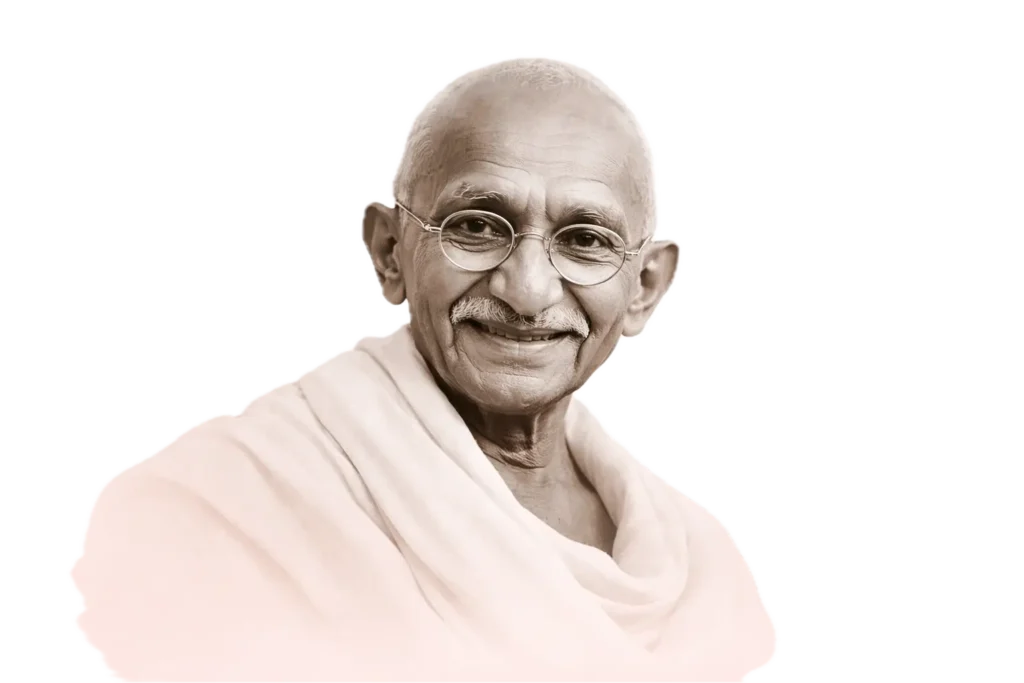
Gandhi’s public life was shaped by a few central ideas that he returned to again and again. He did not treat them as abstract theories meant only for books or speeches. He tried to test them in conduct, in politics, in community life, and in everyday human relations. This page brings together some of the ideas most closely associated with him and offers a simple path into them.
A way of thinking rooted in conduct
For Gandhi, ideas were not meant to sit apart from life. Truth and nonviolence, in his view, were not private virtues to be admired from a distance; they had to be brought into public life, social conduct, and even politics. That is what gives his thought its distinct character. He kept asking not only what was right in principle, but what could be lived honestly in practice.
Truth at the center
Truth stood at the center of Gandhi’s thought. He treated the search for truth as a serious discipline rather than a possession one could claim once and for all. On the mkgandhi.org selection pages, truth is described in a way that leaves room for humility: people see it partially, from different angles, and must therefore approach one another with tolerance as well as conviction.
For that reason, truth in Gandhi’s thought is not harsh certainty. It asks for self-scrutiny, patience, and the willingness to suffer for what one sincerely believes, while also remembering that no one sees the whole of reality perfectly.
Nonviolence as strength
Ahimsa, or nonviolence, was not for Gandhi a timid refusal to act. He treated it as a demanding discipline of courage, self-control, and moral clarity. The source material repeatedly makes the point that nonviolence was meant for the brave, not for the fearful, and that it had to reach beyond private conduct into collective life.
He also did not reduce ahimsa to mere harmlessness. In the texts gathered on mkgandhi.org, nonviolence appears as active goodwill, restraint, and resistance to wrong without hatred toward the wrongdoer. That is why Gandhi could see it as both deeply personal and fully public.
Holding fast to truth
Satyagraha grew out of Gandhi’s attempt to join truth with nonviolence. It was not simple passivity, and it was not mere refusal. The source pages describe it as a form of disciplined action in which one first appeals, reasons, explains, and tries every peaceful means before resorting to direct nonviolent resistance.
What mattered most to Gandhi in satyagraha was not numbers, noise, or speed, but quality, discipline, and moral seriousness. A satyagrahi was expected to act calmly, to avoid hatred, and to accept suffering rather than inflict it. In that sense, satyagraha was both a political method and a test of character.
The path matters
One of Gandhi’s clearest and most demanding ideas was that the means used to reach an end cannot be separated from the end itself. In Selections from Gandhi, he says this plainly: the means are like the seed and the end like the tree. The shape of what grows depends on what is planted.
This is one reason his politics took the form it did. He did not believe that violence, deceit, or moral carelessness could produce a just and humane future. For him, the discipline of the journey was already part of the destination.
More than political independence
Swaraj is often understood simply as self-rule in the national sense, but Gandhi’s use of the word ran deeper. The materials on mkgandhi.org connect swaraj not only with political freedom, but with self-restraint, responsibility, and disciplined living. It is both public and personal.
That wider understanding matters. Gandhi did not imagine freedom as a mere transfer of power. He linked it to the ability of individuals and communities to govern themselves responsibly, without dependence, excess, or domination.
Nearness, responsibility, and self-reliance
Swadeshi, in Gandhi’s thought, was not a narrow slogan. It was a principle of responsibility toward what lies nearest: one’s labour, one’s community, one’s local obligations, and forms of economic life that do not rest on exploitation. In the source material, swadeshi is closely tied to swaraj and appears as part of a larger moral and social vision.
Seen this way, swadeshi is less about hostility to the outside world and more about rebuilding life from the ground up — through local work, restraint, and a refusal to let economic life drift away from moral concern.
Wealth held in trust
Gandhi’s idea of trusteeship was his attempt to think about wealth without glorifying either greed or violent confiscation. In the Village Swaraj material, the doctrine is explained as a way of asking those with more than they need to regard themselves as trustees of what remains, holding it for the benefit of society rather than as absolute personal entitlement.
Whether or not one agrees with it fully, trusteeship shows something basic in Gandhi’s economic thought: he could not separate economics from ethics. He believed that a deeply unequal society could not remain nonviolent for long, and that some form of moral responsibility had to enter the question of wealth.
Decentralized life and human scale
Gandhi’s writings on village swaraj return repeatedly to decentralization, local production, dignity of labour, and the idea that the human being must remain the central concern of economic and political life. The text on mkgandhi.org says this directly: “The supreme consideration is man,” and argues that centralized systems sit uneasily with a nonviolent social order.
This does not make village swaraj a matter of nostalgia alone. At its heart is a question Gandhi kept raising: what kind of social order allows people to live with dignity, work meaningfully, and avoid becoming powerless before distant systems of wealth and control?
Duty before claim
Another recurring Gandhian idea is the relation between rights and duties. In Selections from Gandhi, he argues that rights grow naturally out of the faithful performance of duty. This does not dismiss rights; rather, it places moral responsibility at the center of public life.
That way of thinking runs through much of his work. Gandhi kept returning to the question of what one owes — to truth, to neighbour, to labour, to community, to conscience — before asking what one may demand.