

The Life of Mahatma Gandhi
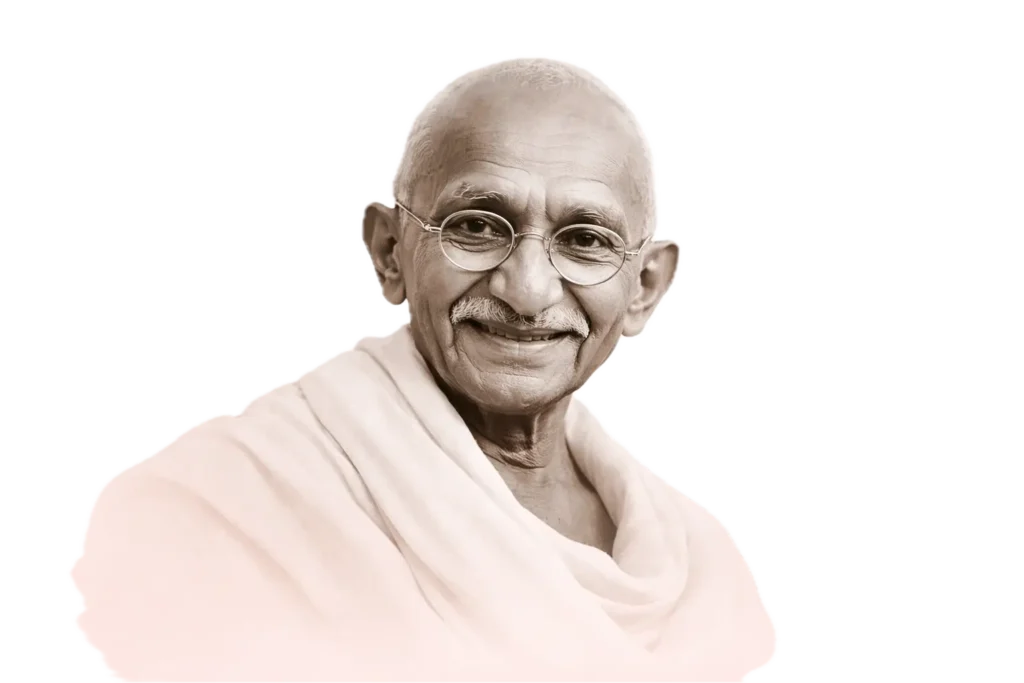
Introduction
Gandhi’s life stands at the meeting point of personal discipline and public history. He was born when British rule in India seemed firmly established, and he died after India had become free. The source biography presents that span not just as the story of one political leader, but as the journey of a man whose moral force came to matter far beyond India itself.
What makes his life so striking is that it did not begin in any extraordinary way. The source is careful on this point: Gandhi was not presented as a child prodigy or a figure marked out from the beginning. He grew through effort, self-examination, and an unusually persistent search for truth in ordinary human life.
Birth & Upbringing
Mohandas Karamchand Gandhi was born on 2 October 1869 in Porbandar, in Kathiawar, on the western coast of India. He came from a family connected with public service: both his grandfather and his father, Karamchand Gandhi, served as Dewan. The source also places great importance on his mother, Putlibai, whose gentle and devout nature left a lasting impression on him.
As a boy, Gandhi was shy, serious, and by his own later recollection not especially brilliant at school. Yet the source preserves small incidents that already suggest something important in him: a dislike of deceit, a strong inward conscience, and an early habit of testing conduct against what he felt to be right.
Youth & Study in England
After matriculation, Gandhi briefly attended Samaldas College in Bhavnagar, but did not settle there comfortably. A family adviser suggested that if he wished to follow his father’s path in state service, he should qualify as a barrister in England. Before leaving, he gave his mother a solemn promise that he would avoid meat, wine, and sexual misconduct while abroad.
He sailed for Southampton on 4 September 1888, even though crossing the sea brought him into conflict with caste opinion at home. England widened his world, but it also tested him. He had to adapt to unfamiliar customs while holding on to the vows and disciplines that had accompanied him from India.
On the threshold of Manhood
When Gandhi returned to India, he learned that his mother had died while he was away, a loss the family had concealed from him during his time in England. He tried to establish himself in legal practice first in Bombay and then in Rajkot, but these early professional years were marked more by uncertainty than success. The source even recalls his nervousness in court and his inability, in one case, to speak.
This unsettled period ended when Dada Abdulla & Co. offered him work connected with a legal matter in South Africa. He accepted and sailed there in April 1893. What looked like a professional opening would become the decisive turning point of his life.
South Africa & The Emergence of Gandhi
South Africa changed Gandhi from a young barrister into a public worker. The source treats these years as the beginning of a deeper transformation. What started as legal employment gradually became a life of service shaped by questions of justice, dignity, and the treatment of Indians under racial discrimination.
After several years there, Gandhi found that he could no longer step away from the cause he had taken up. Even when he returned briefly to India, he used the visit to draw attention to the condition of Indians in South Africa. The source also notes his sanitation work during plague in Rajkot, showing that his instinct for service was widening beyond the courtroom into public life.
Return to India
When Gandhi came back to India in January 1915, he returned very differently from the man who had left in 1893. The source describes him as coming home with no possessions and with a single desire: to serve. Yet it also emphasizes that he did not assume he already understood India. Following Gokhale’s advice, he spent time observing the country before placing himself fully in its politics.
This matters because it shows the patience in Gandhi’s method. He did not begin by declaring answers. He began by listening, travelling, and learning. The public figure who emerged in India was shaped as much by this attentive period as by the struggles that followed.
Gandhi and the Masses
The source identifies the Rowlatt Bill as the moment that brought Gandhi decisively into all-India politics. From that point until his death in 1948, he stood at the center of India’s public life. But what made his leadership different was not only scale. It was the attempt to awaken people while also restraining anger from turning into violence.
His gift was to turn politics into something ordinary people could enter with moral seriousness. Protest, in his hands, was not meant to be mere outburst. It was meant to be disciplined, sacrificial, and tied to conscience. That is why his role in India’s freedom struggle cannot be measured only in campaigns or negotiations; it has to be understood as a reshaping of public action itself.
England Again
The source next moves to Gandhi’s journey to London for the Second Round Table Conference after the Gandhi-Irwin Pact. Politically, the visit did not bring the result he hoped for. Yet the biography suggests that it still mattered because it allowed British people to see him directly rather than through rumor, admiration, or caricature.
This chapter also reveals another side of Gandhi: simplicity, humor, warmth, and personal presence. Even when formal politics disappointed him, his character continued to make an impression on those who met him.
Quit India
With the outbreak of war in 1939, Gandhi was drawn again into the center of political struggle. The source shows the moral tension of this period clearly. He had come to regard war itself as wrong, yet he also refused to treat Britain’s crisis as something to be exploited in a spirit of revenge or opportunism.
That position reveals something essential in him. Even at moments of intense national conflict, Gandhi tried to keep means and ends tied together. Freedom, in his view, could not be rightly sought through moral collapse.
Freedom and Martyrdom
The final phase of Gandhi’s life unfolded in the shadow of communal violence, Partition, and deep human suffering. The source recounts Direct Action Day, the violence that followed, and Gandhi’s repeated efforts to restore peace through presence, persuasion, and fasting. It notes, too, that while the country celebrated independence on 15 August 1947, Gandhi was in Calcutta, occupied not with ceremony but with the work of healing.
In January 1948 he undertook another fast in Delhi for communal harmony. On 30 January 1948, he was assassinated on his way to evening prayer at Birla House. The source closes this chapter with Nehru’s famous broadcast words on the loss the country had suffered.